 Original
October 1860Color reconstruction
prototype demo
Prototype note: the right side currently uses the original image with a simple visual treatment only to demonstrate the slider. Replace it with the researched Colors of History color reconstruction before publication.
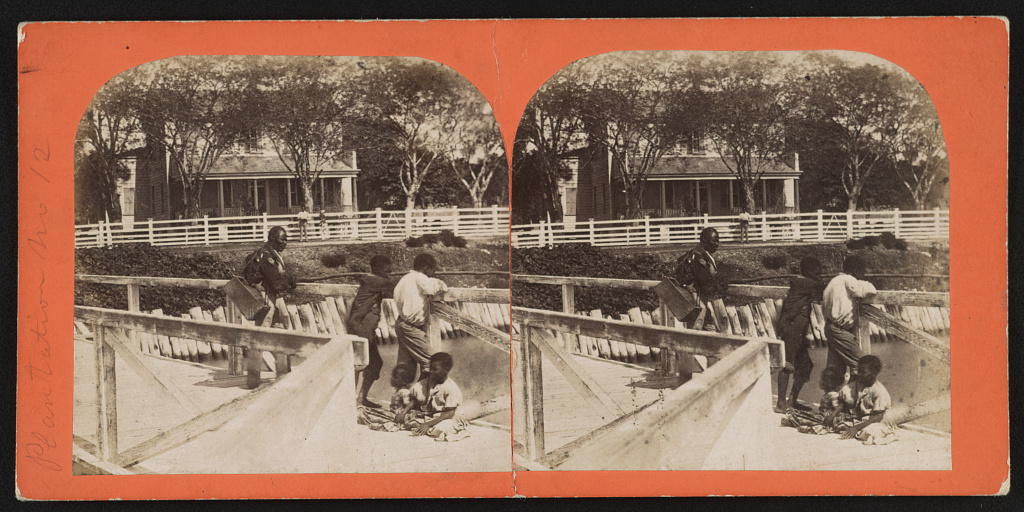
Plantation no. 12, Rockville Plantation, near Charleston, South Carolina. Osborn & Durbec, October 1860. Library of Congress, LC-DIG-stereo-1s03922. The catalog lists “no known restrictions on publication.”
A photograph that does not know what comes next
Nothing in the frame announces a national crisis. A man identified in the catalog as Old Bacchus fishes from a bridge. Two boys look down into the water, while two other children sit on the bridge.
The date changes how the scene reads. Osborn & Durbec made the photograph in October 1860. Abraham Lincoln was elected the following month, South Carolina seceded in December, and the Civil War began in April 1861.
What the archive says — and what it does not
The photograph does not give us the children’s names. The Library of Congress catalog says that, based on the date and location, the children are most likely enslaved. That wording is important: it is a documented archival assessment, not certainty supplied by Colors of History.
We do not invent biographies where the archive is silent. Visual details can be examined and the historical setting can be documented, but uncertainty remains part of the record.
Why the quietness matters
The image preserves ordinary human attention—the simple act of watching someone fish—inside the structure of a slave society on the eve of civil war. That tension is part of what makes the photograph so arresting.
From still image to narrated history.
Sources & provenance
- Library of Congress catalog record — title, scene description, creator, October 1860 date, collection metadata, and rights advisory.
- Creator: Osborn & Durbec.
- Reproduction number: LC-DIG-stereo-1s03922.
- Repository: Library of Congress Prints and Photographs Division.